The questions Arabic and Middle Eastern couples ask most often when planning a destination wedding in Europe.
Do you perform at Arabic weddings in Europe?
Yes. Alongside my work as one of Europe's leading Persian wedding DJs, I regularly perform at luxury Arabic and Middle Eastern weddings across Italy, France, Greece, Spain, Portugal and Switzerland — most often for Arabic-American and Arabic-Canadian couples travelling from the United States and Canada.
Which countries do you cover as an Arabic wedding DJ?
The most requested destinations are Italy (Lake Como, Tuscany, the Amalfi Coast, Venice), France (the French Riviera, Paris, Provence, Bordeaux), Greece (Santorini, Mykonos, Athens, Crete), Spain (Marbella, Mallorca, Ibiza, Barcelona), Portugal (the Algarve, Lisbon, Comporta) and Switzerland (Lake Geneva, Lucerne, St. Moritz). I also travel across Germany, the UK, Austria, the Netherlands and beyond — the
full country map is on the homepage.
Do you play Lebanese, Egyptian and Levantine music?
Yes. The repertoire spans Lebanese and Egyptian classics, Levantine and Syrian wedding standards, modern Arabic pop, North African and Moroccan sounds, and the Arabic hits your guests expect to hear. It is programmed by family, generation and moment — not from a single generic playlist.
Can you blend Arabic music with House and international hits?
That blend is the core of what I do. Arabic classics move into Oriental and Arabic House, Afro House and Organic House carry the late evening, and international hits, R&B and commercial House keep every generation on the floor. The transitions are the craft — the room should never feel a gear change.
Do you offer live percussion or live musicians?
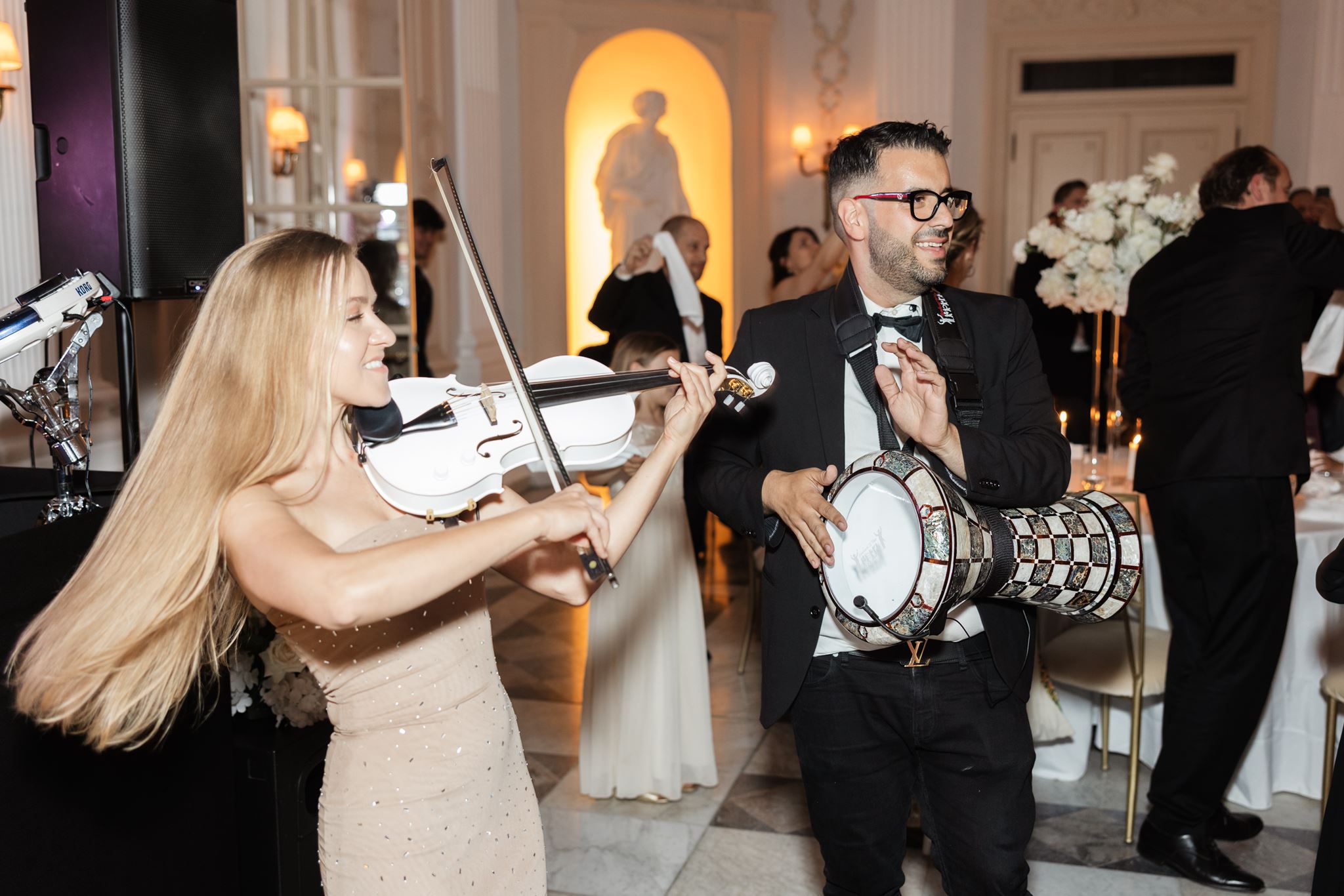
Yes. Live drums layered over the DJ set are a signature element, and live saxophone, violin or additional percussion can be added. For Arabic weddings this works particularly well for the zaffa entrance, the first dance and the peak of the night.
Can you handle a zaffa entrance?
Yes. The zaffa is choreographed with you in advance — timing, entrance route, the exact track and cue, the handover to any live zaffa troupe, and the transition into the first dance. Sound levels and microphone placement are planned so the entrance carries the room without overwhelming it.
Do you provide sound and lighting for destination weddings?
For destination weddings the sound and lighting is supplied by your venue or a local production company, which keeps costs down and avoids shipping equipment across borders. I provide a detailed technical rider your planner or supplier can work from directly, and I liaise with the production team before the day.
View the technical rider →
Do you work with wedding planners and luxury venues?
Constantly. Most luxury destination weddings are run by a planner, and I work to their run sheet: sound checks around the ceremony, coordination with the production and lighting teams, respect for villa and hotel curfews, and clear communication with the venue's events manager.
Do you play at alcohol-free and conservative celebrations?
Yes, and often. Energy comes from the music and the room, not from the bar. Where a family requests it, I can also work with separated celebrations, adjusted repertoire, or a defined start of the music after the ceremony — this is agreed in advance so nothing is left to chance on the day.
How far in advance should we book?
Peak-season Saturdays between June and September are frequently reserved 12 to 18 months ahead. For a multi-day celebration with a welcome dinner, a mehndi or henna night and a main reception, the earlier the better — I hold only one wedding per weekend.
Which languages do you speak?
English, German and Persian. Announcements can be kept minimal and elegant, delivered by your MC, or handled bilingually — whatever suits the tone of your celebration.
Can you cover a multi-day celebration?
Yes. Welcome dinners, henna and mehndi nights, the main reception and the closing brunch can all be covered as one engagement, each with its own musical identity so the days build rather than repeat.